
Help! Where do I go from here? Part I: Poetry.
The Poetry Challenge and a Month of My Favorite Poems

“Why Literature Still Matters” is celebrating its first birthday this month! To thank my supporters, I wanted to make the audiobook version available here, on Beauty Matters. You can listen to the “Preface” below to see if it’s any good. You can get the print edition here, or off of “Corporate Books.com.”
I woke up the other day and couldn’t remember where I was.
I’ve been traveling a lot this semester to speak about Why Literature Still Matters, as well as my new translation of Purgatorio, and thus, inevitably, all fall long, I’ve spent a Thursday in some non-placy Holiday Inn or a Friday in a generic Hampton Inn or some Wednesday in a perfectly predictable Homewood Suites. (Digression: my readers know how I feel about non-places. So do my students. In fact, they’ve started to use the term, too, either that or their own coinage—“non-placy”—to describe the fake places they pass through in their lives. In fact, one of my students, Oscar, at the very moment I was writing this piece, sent me this image:

Isn’t it beautiful? He included this caption: “ultimate non-place.” I feel this is a huge success. In fact, my wife, picking up on this pride of mine, now says: “Every time a ‘non-place’ is identified, an Angelico gets his wings.”1 )
Given the extent of my travels and the nature of my lodgings, perhaps I shouldn’t be too surprised that, the other day, while I was rummaging around a generic lobby inside The Corporate Inn—same chairs, same decorating scheme, same nutrition-less breakfast food—looking to fill a styrofoam cup with styrofoam coffee, I forgot where I was. I just stood there for a couple of minutes looking around and wondering: Wait, where am I? What city am I in? What state am I in? The nice lady behind the desk seemed alarmed and quickly looked away. For a moment, I was perfectly lost and disoriented, uploaded into the great cloud of non-places.
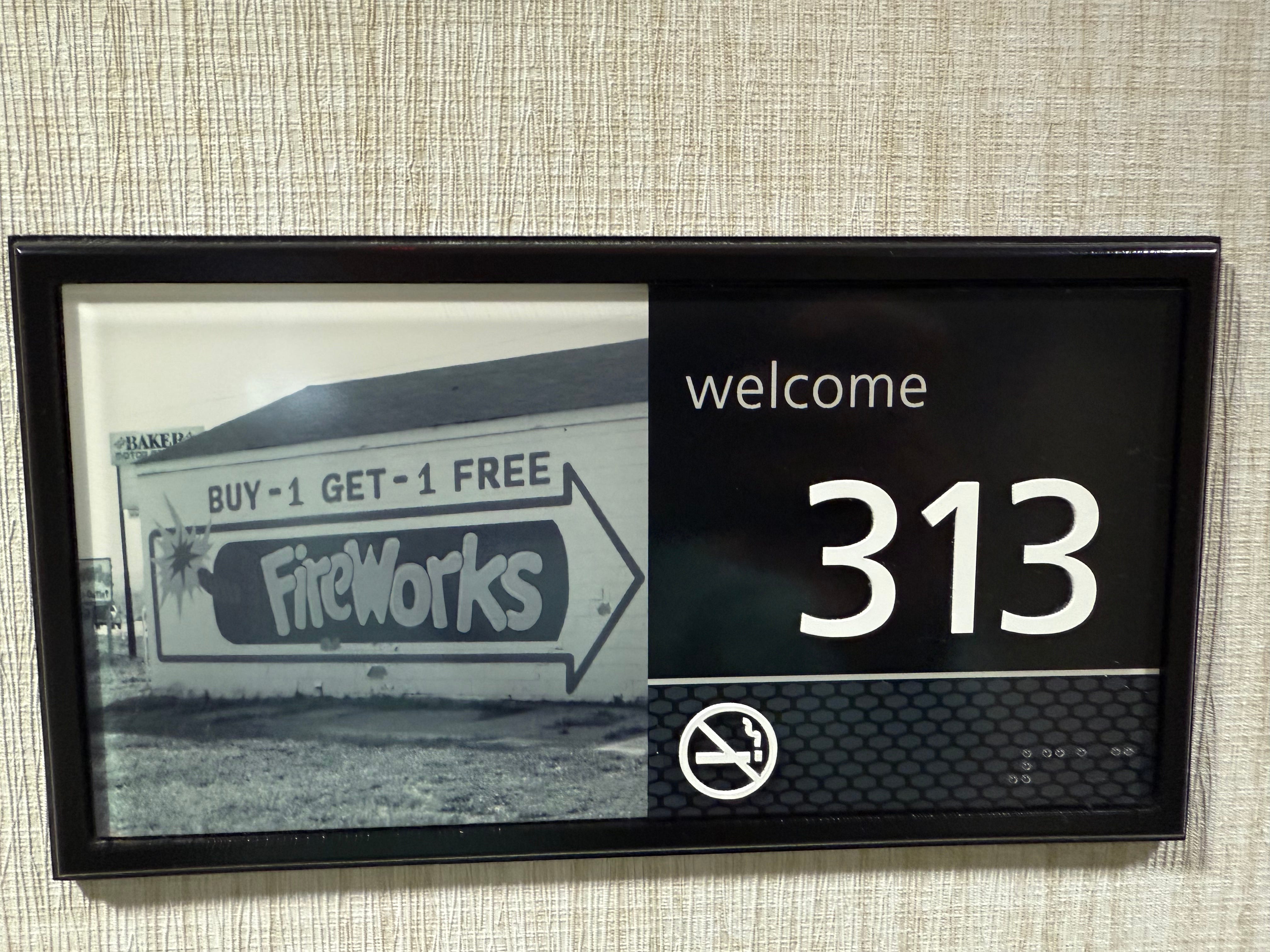
No wonder that upstairs, outside each of the rooms, Non-Placy Hotel not only hangs up numbers next to the doors, but also little viby pictures of quirky road signs or rustic restaurants or memorable, small-town BBQ joints or, for my room, an old-fashioned fireworks stand (wait: does Corporate Inn read my Substack? They must know how I feel about fireworks stands: very memorable.)
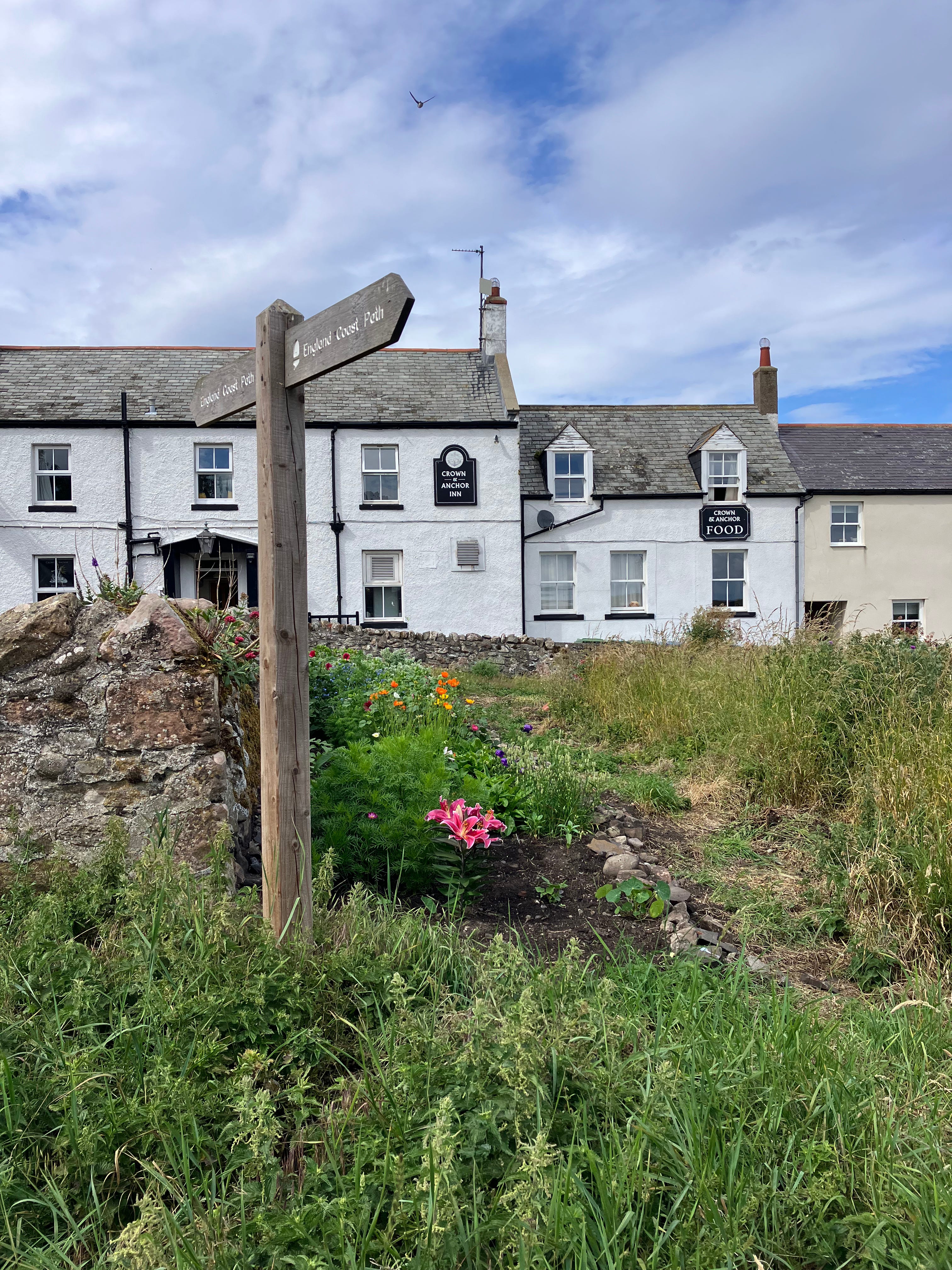
You’ll be happy to know that I did, eventually, remember where I was (the third cup of revolting hotel coffee helped), and I also remembered how to get home. But while I was coming home, I couldn’t help contrasting my experience of corporate amnesia in Non-Place Hotel with this summer on Lindisfarne. When I was on Holy Island with my students, we not only met real people, but we also stayed in real places, the sort of inns that Belloc warned us we would lose if we didn’t love them (in “On Inns”):
Meanwhile, on the inside… I sat, drinking a really good cider, with my back to the wall, just waiting for Long John Silver to walk through the door…
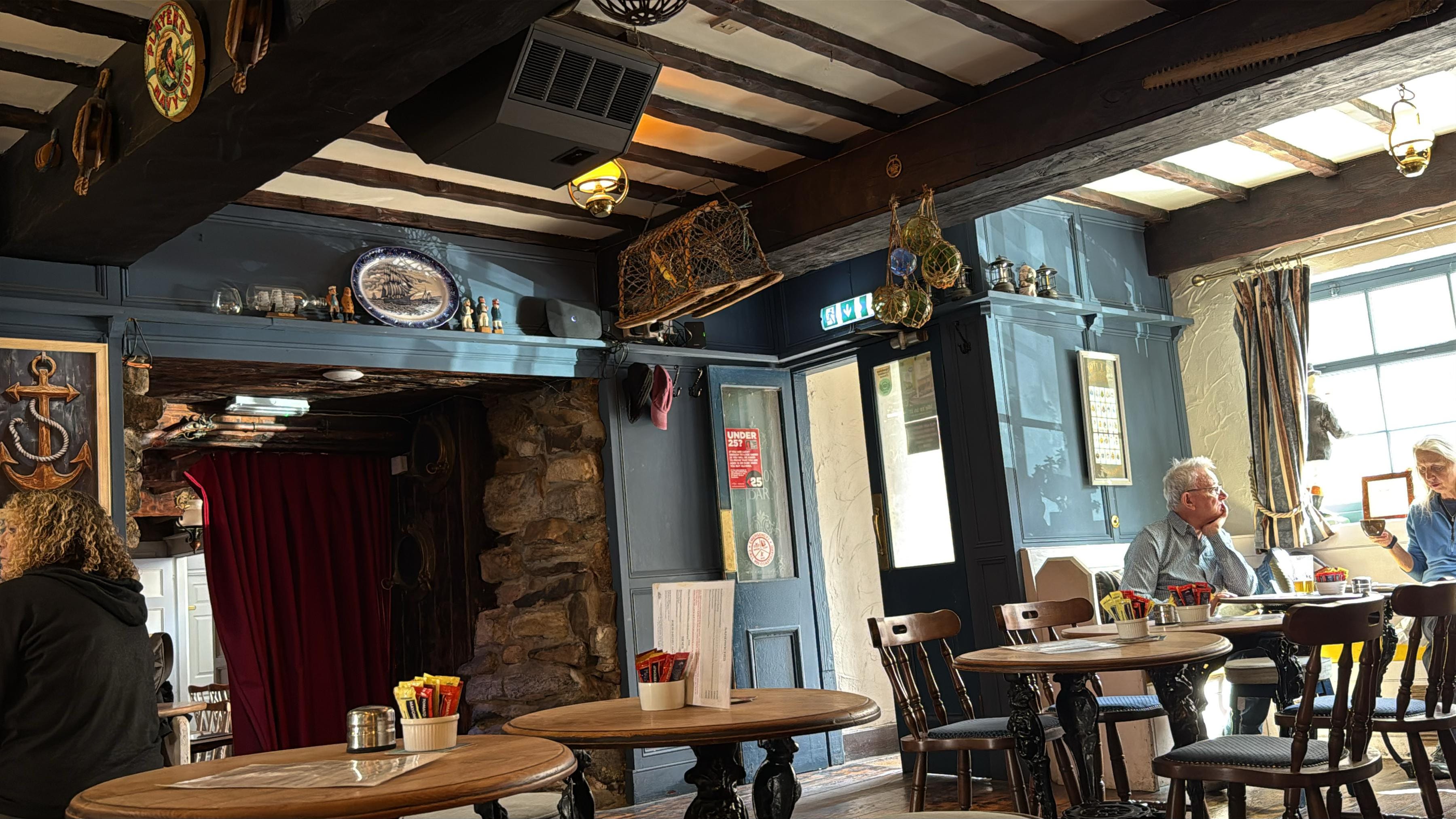
The overworked, irascible innkeeper, Paul—who was also the bartender, the waiter, concierge, manager, and cashier—had no time to spare for corporate smiles, and yet, if you are persistent and polite enough, he will come over and talk to you, in his spare minutes between customers, and ask you where you are from, try to get news of the world, and complain to you about his customers. I kept marveling that my experience in The Ship Inn was probably not substantially different from what it would have been in the era of Captain James Cook. My cell phone didn’t even work, because the old building was built of stones so thick you couldn’t get reception.
You note the irony? Real places are being consumed in order to make space for more and more Corporate Inns. We not only bulldoze the quirky, the local, and the imperfect to make room for non-places, but then we use the images of those real places that had to die to assist the advance of progress. The viby pictures make up a gallery of ghostly memories of the places the non-places consumed and digested, so that their inmates won’t completely forget where they are.
I think I’ll send my image of The Ship Inn, above, to The Corporate Inn, so they can hang it outside of Room 387 in Toledo.
I’m not the only one who worries about this kind of self-inflicted amnesia, of course. What I call the “logic of non-places” is what Paul Kingsnorth, in his most recent book, has called “the machine”; in his poem, “A Timbered Choir,” Wendell Berry calls it, “The Objective”:
Even while I dreamed I prayed that what I saw was only fear and no foretelling…
Every place had been displaced, every love
unloved, every vow unsworn, every word unmeant
to make way for the passage of the crowd
of the individuated, the autonomous, the self-actuated, the homeless
with their many eyes opened toward the objective…Those who had wanted to go home would never get there now…
Philip Larkin wrote about it in the my third-favorite depressing poem, “Going, going”:
[…] The crowd is young in the M1 cafe;
Their kids are screaming for more—
More houses, more parking allowed,
More caravan sites, more pay…
And that will be England gone,
The shadows, the meadows, the lanes,
The guildhalls, the carved choirs.
There’ll be books; it will linger on
In galleries; but all that remains
For us will be concrete and tyres.
And Betjeman wrote a poem—which he later had to apologize for—in which he imagined bombs erasing the fake town of “Slough’’:
Come, bombs and blow to smithereens
Those air-conditioned, bright canteens,
Tinned fruit, tinned meat, tinned milk, tinned beans,
Tinned minds, tinned breath.
Isn’t it interesting that poets are so sensitive to the disappearance of places and seem to suffer peculiarly acute allergic reactions to non-places? Why is that? I think because poets spend their lives learning to use words to make language homey, textured, memorable: indeed, unforgettable. They do for their little poems what my surly innkeeper, Paul, did for his inn: they help us move from “being-in-the-world” to “being-at-home” within the world.
I also think that this is why, over the past year, I’ve been telling people: “start with lyric!” No matter the audience or the part of the story I’ve been trying to tell (about Zuckerberg and Yeats in lecture halls; advice to home-schooling moms about how to die in Sardinia, on podcasts; explanations to classical educators about how we lose our souls by taking selfies on Iceland), the one thing everyone says at the conclusion of my talk is: “Okay, fine. We think that what you describe is happening. It’s worrisome. But where do we go from here?” I’ve heard this question after lectures, in emails, from eager students. Sometimes I answer that question like this:
“Could you start with lyric? Could you read one poem per week; or, better yet, could you take my Poetry Challenge? Could you read one poem per day, every day for a month, and memorize one single poem, that speaks to you? Memorizing a poem that touches your heart is the gold standard of closing the gap between what you see and who you are (For inspiration, I’ll included the list of poems I inherited and helped to curate when I taught at Wyoming Catholic College…). In fact, I myself am currently working on Yeats’s ‘For Clapping Hands of All Men’s Love.’”
But I’ve found that even this comment is of limited assistance, because the next question is: Ok, well, sure, but where do you go for that? We know about the anthologies for children—it’s our craft—and it’s certainly good to have your five-year-old memorize poems about purple cows and how you’d rather see than be one, but what about us, the inmates of non-places, who need more nutritional value than what is provided in Gelett Burgess?
It must have been for this reason that my students were so delighted to get my list of twenty-five poems—a list I’ve expanded for you to a month’s worth, thirty-one (plus, a little cheating… to sneak in a few extras). The idiosyncratic list below is made up of hard-won poems, which I stumbled across and was deeply moved by (like Blake’s “Auguries of Innocence”); or poems I was introduced to by beloved professors (David Lyle Jeffrey led a little poetry seminar for me once on Schnackenberg’s “Supernatural Love”); or things I’ve come to love because my students are always moved to the core when they encounter them for the first time (Hecht’s “A Hill” and Wilbur’s “Advice to a Prophet”); or poems I was given by beloved mentors in times of need. When I was younger and applied for a job at my own personal Ithaka, then didn’t get the position, I was heartbroken. But that’s when a beloved professor at that institution gave me a printed-off version of “Ithaka” with a note, scrawled out in blue pen in the margins: “don’t worry, you’ll get home.” It’s now my favorite poem. In fact, for a while I wondered if any poem not given to you by a beloved professor was even worth reading. But then you also come upon poems that manage to weave a “net” (as Lewis liked to put it) so fine that it can capture some elusive experience—like grief—within the mesh of its subtle craft. Should it surprise us that Elizabeth Bishop or W. H. Auden, when they talk about devastating loss, need to make poems of such formality, to keep it together?
Readers of Why Literature Still Matters also know that I have a weakness for ekphrasis: the attempt to convert the visual arts into poetic art. To that end, I admire, not only George Herbert and Auden, but even the very modern of John Berryman, who makes us feel in words the floating, suspended feeling you get when you look at Bruegel’s paintings of winter.
You might also try to pepper and salt the calendar of your days with poems that aim to capture the essence of those turning seasons (look at my seasonal poems below). In Why Literature Still Matters, I claim that poetry has the “logic” of the circle as opposed to our “linear” (or “parabolic”) world of endless acceleration. Ritualistically marking seasons, feasts, holy days, helps us “slow” the consumeristic race of mere calendrical days:
In the Christian calendar, each day is meaningful. In the post-narrative era, the calendar is de-narrativized; it becomes a meaningless schedule of appointments… Without a narrative, there are no festivities, no festive times—no festive moods with their intensified feeling of being. All that is left are work and free time, production and consumption. In the post-narrative era, festivities are commercialized. They become events and spectacles. (Byung-Chul Han, The Crisis of Narration, viii)
For this reason, in my family, we read Dylan Thomas’s “A Child’s Christmas in Wales” every Thanksgiving; act out plays in the living room on Black Friday; chant the “O Antiphons” in the week leading up to Christmas; read Keats’s “To Autumn” on Halloween; listen to St. Matthew’s Passion during Lent, Benjamin Britten’s Ceremony of Carols on Christmas day, and Beethoven’s Ninth Symphony on New Year’s Day. It’s a way of letting the sacred liturgy give shape and, thus, redeem our secular time.
Remember, too, that Dana Gioia reminds us that the arts will stand or fall together, and so I love when contemporary composers set old poems to music (see Pärt’s setting of Burns’s “My Heart Is in the Highlands”), or John Adams’s setting of “Batter My Heart.” And, if you were made to memorize Robert Frost’s “Stopping by Woods on a Snowy Evening” in high school, you might have become “deaf” to it, but Eric Whitacre can restore your power to hear the words.
Elsewhere, I have had more to say about how to study a poem, but for now, when you do read them (one per day over the next month, right?), read them slowly and out loud. Don’t feel rushed. Go back over a curious line and mutter it to yourself again. Furrow your brow, often, and mumble to yourself (or to your spouse over coffee): “Wait, what does that mean? Why did he say it like that?” If you’re reading an older poem, you’re going to have to look up a word or two in the dictionary, aren’t you? No avoiding that. But while you’re there, be sure to read the etymology: wake up those root images asleep inside words. Be “radical.” Go to the roots. Make your lived world a home.
What am I missing?
The Poetry Challenge: Poems for a Month
1) C. P. Cavafy, “Ithaka.”
2) Anthony Hecht, “A Hill.”
3) Richard Wilbur, “Advice to a Prophet” or “Love Calls Us to the Things of This World.”
4) John Keats, “Ode on a Grecian Urn” or “Bright Star.”
5) Gjertrud Schnackenberg, “Supernatural Love.”
6) Gerard Manley Hopkins, “The Windhover.”
7) Elizabeth Bishop, “One Art.”
8) Malcolm Guite, “My Poetry Is Jamming Your Machine” or his poems on the O Antiphons.
9) Kathleen Raine, “A Spell for Creation.”
10) John Donne, “La Corona.”
11) W. H. Auden, “Funeral Blues.”
12) Philip Sidney, “Leave Me, O Love.”
13) William Wordsworth, “London, 1802.”
14) Robert Frost, “For Once, Then, Something” or “Acquainted with the Night.”
15) James Matthew Wilson, “St. Thomas and the Forbidden Birds” or Dana Gioia, “Insomnia” or “A Prayer on Winter Solstice” or “Prayer” (read with Herbert’s “Prayer,” below).
16) Thomas Gray, “Elegy in a Country Churchyard.”
17) W. H. Auden, “Musée des Beaux Arts” or “The Labyrinth” or “Secondary Epic” or “Shield of Achilles” or “September 1, 1939.”
18) John Donne, Holy Sonnets (especially with John Adams’s setting of “Batter My Heart”).
19) Robert Burns, “My Heart Is in the Highlands” (especially in Arvo Pärt’s setting).
20) John Berryman, “Winter Landscape.”
21) Gerard Manley Hopkins, “Binsey Poplars” or “As Kingfishers Catch Fire.”
22) Henry Vaughn, “The Storm.”
23) Percy Bysshe Shelly, “To a Skylark” (especially with Ralph Vaughn Williams’s Lark Ascending).
24) W. B. Yeats, “When You Are Old” or “A Prayer for My Daughter” or “For Clapping Hands.”
25) Really Good Depressing Poems: Sigfrid Sassoon, “Litany of the Lost” or Baudelaire, “Albatross” (translated by Richard Wilbur) or Philip Larkin, “Going, Going” or John Betjeman, “Slough” or Lord Byron, “Darkness” or William Blake, “Mock on, Mock on” or “Auguries of Innocence.”
26) Wendell Berry, “How to Be a Poet” or “A Timbered Choir” (especially as set in the opening sequence to Look and See) or “The Mad Farmer’s Manifesto.”
27) Billy Collins, “The Trouble with Poetry.”
28) Benjamin Myers, “Field.”
29) George Herbert, “Love (iii)” or “Prayer” (read with Gioia’s “Prayer”) or “Virtue.”
30) Emily Dickinson, “Split the Lark.”
31) Seasonal Poems: John Keats, “To Autumn” or Dana Gioia, “Prayer on Winter Solstice” or Wallace Stevens, “The Snowman” or A. E. Housman, “The Snows Are Fled Away” (translation) or Gerard Manley Hopkins, “Spring and Fall” or A. E. Housman, “Loveliest of Trees.”
Honorable Mentions: Patrick Kavanaugh, “The Hospital”; e. e. cummings, “since feeling is first”; Mary Oliver, “The Morning I Watched the Deer”; Geoffrey Hill, “The Violent Bear It Away”; R. S. Thomas, “The Bright Field.”
Poems for Memorization at WCC:
Freshman Year
“To an Athlete Dying Young,” Housman.
“On First Looking into Chapman’s Homer,” Keats.
“God’s Grandeur,” Hopkins.
“The world is too much with us,” Wordsworth.
“Stopping by Woods on a Snowy Evening,” Frost.
“What a piece of work is a man,” Shakespeare.
Sonnet 116, Shakespeare.
“Spring and Fall,” Hopkins.
Sophomore Year
“Pied Beauty,” Hopkins.
“Ozymandias,” Shelly.
“To Lucasta, Going to the Wars,” Lovelace.
Junior Year
Holy Sonnet XIV (“Batter my heart”), Donne.
“Love III,” Herbert.
General Prologue to The Canterbury Tales, Chaucer.
“The quality of mercy is not strained,” Shakespeare.
“Sonnet 94,” Shakespeare or “For once then, Something,” Frost“The Tyger,” Blake.
“The Lake Isle of Innisfree,” Yeats or “When you are old,” Yeats.
Senior Year
“Because I could not stop for death,” Dickinson.
“Fire and Ice,” Frost.
“The Second Coming,” Yeats.
My students in Benedictine’s Center for Beauty and Culture are known as Angelico Fellows.