

This spring promises to be an exciting one for a certain hard-working Dante scholar from Kansas: Well-Read Mom and Ascend Podcast will be using my translation of Purgatorio during Lent!
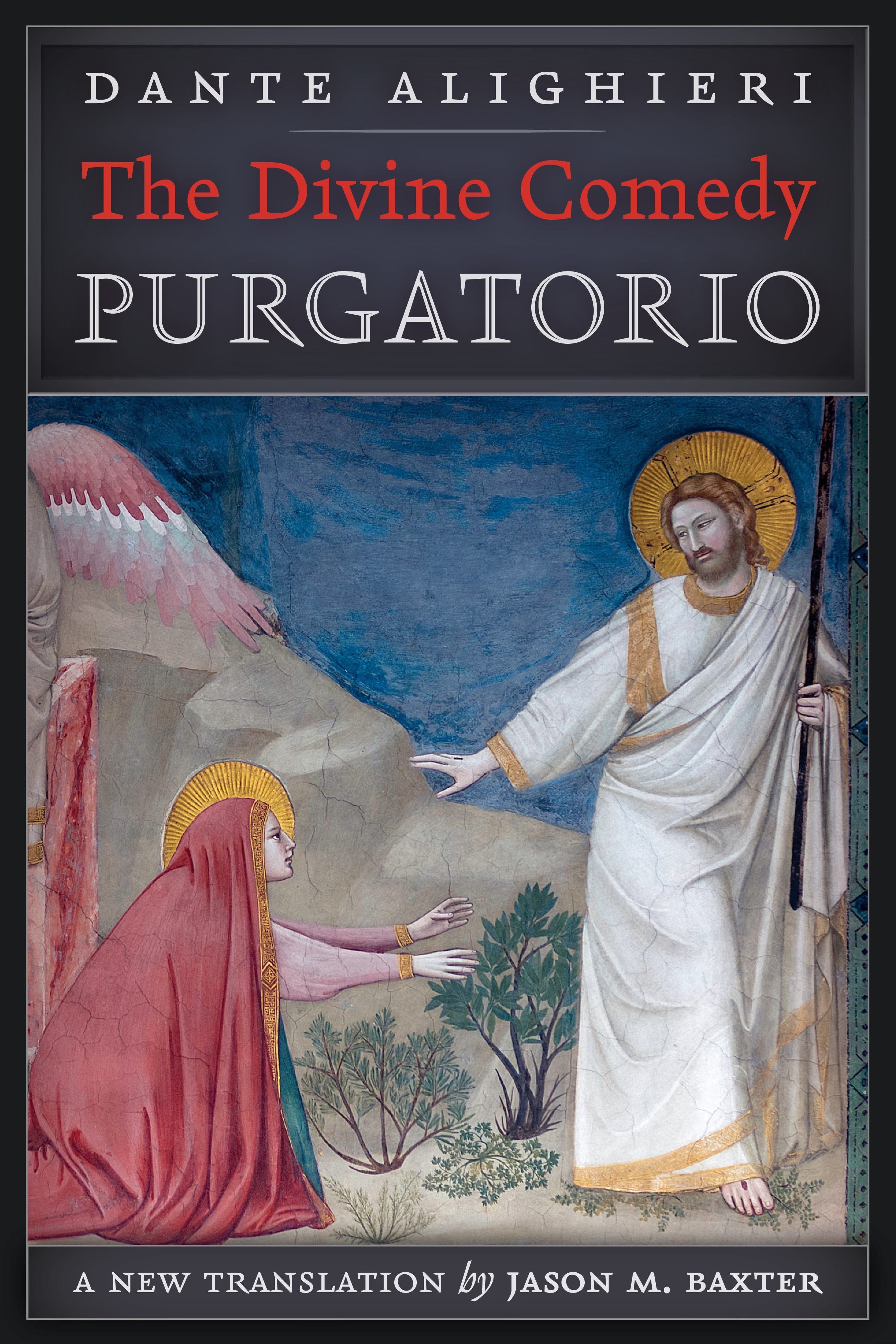
As a companion for my readers, I’ve also made a new audiobook (you can listen to Canto 1, above): partly because I don’t love anything currently on the market, and partly because you asked me to! Many of my readers told me that if they could hear the cadence and inflection I used in reading the ink and paper version, they could better feel the emotional urgency of Dante-the-narrator; they’d get a better sense for the many minor characters (like my beloved Pia in Purgatorio 6); and they could also hear the magic of the poetic “soundtrack” which, I claim in the introduction, makes up such an important part of the experience of the poem.
But then it happens: you get into the studio and all of a sudden you find even more things you want your listeners to hear and feel and experience. Purgatorio is a tapestry of sounds: there are fragments of song and chant everywhere, and so I sing them. Purgatorio is a collage of quotations from biblical and liturgical Latin, kneaded into the daily bread of our vernacular, and so I read the Latin. And there is even a passage… in Occitan! You can listen to me reading this wonderfully weird blend of Spanish, French, and Italian at the end of Purgatorio 26. Furthermore, in my audiobook, Dante, Virgil, Cato, Beatrice, and the many other speakers throughout the poem get their own personalities. My Virgil is pedagogical and sometimes a bit avuncular. Dante-the-pilgrim is sincere, curious, eager, and a little overwhelmed, while Dante-the-poet/narrator is the convicted, authoritative prophet, who speaks with wild-eyed zeal. And Beatrice? Well, let me know what you think!
Where can you get the audiobook? It’s available in three places:
In my online bookstore;
On Bandcamp (for those who want to listen in a player that can skip from canto to canto);
And it’s also here, on Substack, for my paid subscribers (at a price that’s 50% less than Audible’s monthly subscription!):
Here are the links for my Substack subscribers:
But we need to back up to ask the question that everyone who has interviewed me about my translation wants to know: What’s so special about this translation? What does it do that other good translations don’t?
Readers of my Inferno know how hard I worked to use words that feel sharp, hard, and jagged to the ears; that is, how I labored to make a soundscape that reflects in the very acoustics of the sentences and words the spiritual desolation of that infernal pit. In contrast to the youthful Dante’s attempt to create a poetry that communicated a gliding, timeless, floating approximation of eternity, the older, worldly-wise Dante, now writing from exile, created a poem whose sentences no longer leisurely meandered beyond their stanzas. On the contrary, sometimes two sentences or even three are packed into one three-line stanza. Sometimes verbs drop out entirely. Everything is faster, more aggressive, sharper, and harsher than what the young, dreamy Dante had longed for (see my “What Taylor Swift Taught Dante about Poetry”). In Inferno, we no longer have the classical composer who uses a few grace notes or discordant chords that quickly resolve to pleasing fifths, but rather, what we have is something like a sustained stacking of dissonant chords. Think of Stravinsky’s Rite of Spring, where within the first two minutes you get slapped with an ostinato that repeats the same chord forty times, and you’ll have it. Or as the Master himself summed up his efforts:
If I had rhymes sufficiently hoarse and harsh
to be a fitting match for this sick hole,
on top of which all other rocks exert their weight,
I’d squeeze the juice of my perception
most fully. But because I don’t,
I’ll have to go on speaking, but with a sense of fear,
because it’s not an easy enterprise—no joke!—
to map the center of the universe,
especially in a tongue that calls out, “mommy” and “daddy.” (Inf. 32:1–9)
So much for Inferno. But after all of the harshness and hardness and sublime power of Inferno comes the lyrical sweetness of Purgatorio! And it feels like it would if Schubert came up, unexpectedly, on your playlist after an evening of heavy metal!
In other words, you can immediately feel the difference. If you have an ear for this kind of thing, you’ll find the cool and the color-filled everywhere in Purgatorio. For instance, Dante describes his Valley of the Kings like this:
Between the plain and slope, a winding path
led us along that hollow’s sides: that’s where
the steepness of the hill is diminished by half.
Gold. Fine silver, cochineal, white lead,
and flawless indigo of celestial hue,
fresh emeralds right after being split:
when set upon that grass and near those flowers,
within that hollow, would each have been
outdone, as less is overcome by greater.
But nature didn’t only paint there,
but also from a thousand sweet aromas
made a single new and mingled fragrance. (Purg. 7:73–81)
As we can see from the passage cited above, for Purgatorio Dante draws upon a full range of senses to create a poetry that is a blend of fragrant smells and a rainbow of pleasing colors. He will need every key on the piano. And just so we cannot miss the point, he sometimes weaves all these things together: landscape, flowers, aroma, color, and brilliance. For instance, when Dante is leaving the terrace of the gluttonous, he has this encounter with an angel:
I turned my head to see who spoke:
never has there been within a furnace
a thing of glass or metal as luminous and rosy
as what I saw. He spoke again: “If you would like
to keep on climbing, you’ll need to turn around:
it’s here that those who long for peace ascend.”
His visage stole away my vision,
and so I came behind my learned teachers
just like a man who walks by hearing alone.
And as a May-time breeze, the harbinger
of dawn will come exuding springtime fragrance,
pregnant with the smells of grass and flowers —
that’s what I felt within that breeze that struck
my brow. I even felt his pinions fluttering,
and even these gave off ambrosial scent! (Purg. 24:136–50)
In particular Dante is eager for us to notice two things:
1) that his pilgrim’s ascent is not just a physically taxing vertical ascent, but that this epic pilgrimage is also connected to an ascent of the heart. In other words, as the pilgrim climbs the literal mountain of Purgatory, his heart, becoming cleaner, feels like it is growing wings:
You can walk to San Leo, descend to Noli,
climb up Cacume or Bismantova’s peak, and all
on foot. But here? A man would need to fly,
I mean, to use those agile wings
and feathers of great desire, behind that guide
who gave me hope and gave me light (Purg. 4:25–30).
2) But as the pilgrim climbs and the heart ascends, so does his poetic style! And he so desperately wants us to notice how this elevation of style accompanies the upward motion of the plot that he breaks the fourth wall (using a rhetorical device called apostrophe) to address us directly:
Reader, I know you see that I am raising
my subject, and thus you will not marvel
if now I use more art to reinforce my poem (Purg. 9:70–72).
In this way he thinks his vernacular is inching closer and closer to the power of the Old Masters who wrote in Latin:
And they went on in front, and I, alone,
behind; but I was listening to their speeches,
and these revealed to me the depths of poetry. (22:127–29).
Just you wait until you come to Purgatorio 28: the pilgrim walks back into man’s first home, and Dante uses the smoothest, sweetest words he had access to! I spent more time on that canto than on any other…
If Dante had just done that—elevate his style while describing a literal and spiritual ascent—we would admire him, wouldn’t we? But the fact is he did even more, because at the very time that his style and words become more and more “classical”—more and more worthy of the admiration of Statius and Virgil—we also find him using words that are undeniably lowly and humble and even homely and frumpy. And these little words, rooted in the body and drawn from daily life, rub shoulders with those important, elegant, lofty, soaring, and “classical” words, sometimes in the same passage! My translation, then, goes all in on recreating this wonderfully complicated soundscape, this interweaving of textures, or, what I like to call, Dante’s Fugue. Imagine a gloriously complicated fugue by Bach, in which the right hand plays a series of chordal inversions, rising higher and higher, while playing, simultaneously, a pattern of chords that are descending in the left hand: the piece gets higher and lower, at the same time. This is exactly what happens in Dante’s poetry: it gets more and more classical, more and more Virgilian and Boethian and Statian, while also growing more and more humble, grounded, rooted, and, what we could call, “Franciscan.” In other words, Dante invented a Christian poetry, one that “ascends” upward to those mystical heights, while also “descending” into an ever deeper incarnation and humble embracing of the everyday.
How does a translator try to get at that?
Let me provide you with a taste of a couple of passages where this fugal quality is most prominent (and then you can go read or listen to Purgatorio 10 and 12 and judge for yourself).
Toward the end of Purgatorio 27, Dante has just passed through the “refining fire” that cleanses the distorted love of the lustful. The pilgrim, Virgil, and Statius have one last ascent to make, but while they are climbing a gigantic stairwell that leads to the apex of Mount Purgatory, they have to pause to wait out the night. They make the steps their beds, lean back, and look up at the stars:
And just like goats in tranquil rumination,
who had been rowdy, capricious among
the hills before they’d found repast,
but now in shade are quiet while the sun is hot,
now guarded by the shepherd, who leans upon
his staff and stands to watch their rest;
or like the watchman who sleeps outdoors
and spends the night beside a somnolent herd
and watches lest a beast should scatter them;
just so were we, all three together. And I
was like the goat: and they, the shepherds.
Flanked by walls of lofty rock on either side.
There, little of the outside world could be seen,
except a tiny patch where I could see the stars,
much brighter and larger than is their usual habit.
While ruminating on them and marveling at them,
I was overcome by sleep, the sleep that often
knows the news before it even happens.
In the hour, I think, that in the orient
Cytherea first shone upon the mountain—
in whom the fire of love has always burned!—
there came to me within a dream a lady (27:76–99)
This passage is extraordinary. Not only does it introduce a beautiful, prophetic dream, but it also describes the radiance of the Morning Star (Venus = Cytherea) as “burning” with “the fire of love” (foco d’amor). So far so good. This is the Dante we expected, the one who once said we should only use what I jokingly call “ten-dollar words.” We also experience that spacious, floating feeling as Dante’s elaborate simile leisurely glides from stanza to stanza.
But what we did not expect is the juxtaposition of the lofty, the refined, and the beautiful with the concrete, the bodily, the haptic, and the earthly. Dante does not just look at and admire the stars; he “ruminates” (ruminando) on their beauty, like a goat! He feeds on “the fire of love” and chews on it, in order to draw its nourishment into his being by means of wonder, just as goats crop, bite, chomp, and swallow down the grass they pasture on. Dante does not want merely to look at the “fire of love” but to get it into his heart; he doesn’t want to look on beauty—as I’ve put it in my Why Literature Still Matters—but to eat it.
Dante’s use of unexpectedly concrete and embodied metaphors for intellectual acts is something I labored to bring out in this translation because, too often, even well-loved, best-selling translations of the Comedy made by eminent scholars have inadvertently killed these metaphors and thereby turned Dante’s poetry into something disembodied: too much in the head and too little rooted in the nerves and heartbeat. For instance, one admired translation renders the passage I cited above by replacing the unusual and arresting metaphor of “ruminating” with this: “Amidst such sights and thoughts / I was seized by sleep.” In contrast to, “While ruminating on them and marveling at them, / I was overcome by sleep.” In another passage, the pilgrim tells his master that the answers he has received are so good that they create within him more questions: “Your words … have helped me to dis-cover love, / but this has made me pregnant with more doubts!” (18.40-42). An eminent translator has rendered that line: “But that has left me even more perplexed.” What was in the body—the “womb” of Dante’s mind was “pregnant” with doubts—turns into an intellectual phenomenon, all in the head (“perplexed”). On another occasion, when Dante is speaking with Marco Lombardo, who is disgusted by the world’s greed, the old cavalier experiences a visceral, bodily reaction upon merely hearing Dante’s question:
Deep sighs emerged, squeezed out by sorrow,
into an “Ohh!” then said: “Brother, the world
is blind. It’s clear you’ve come from it.” (16:64–66)
This somatic utterance is rendered by one modern translator: “He heaved a heavy sigh, with grief wrung to a groan.” Dante’s onomatopoeic, bodily grunt of pained exclamation turns into an objective description. I could list at least two dozen more examples.
My translation, then, is built on preserving the complexity of Dante’s poetry and its tendency to blend together different stylistic textures: the classical, the floating, and the cosmological; and the earthy, the earthly, the homely, and the humble. I’ll conclude with one final example.
When one classical poet talks with another classical poet, you would expect them to use the highest possible style, wouldn’t you? And so, when Statius, the “Third Most Important Poet in History” (so Dante thinks), speaks with the “Second Most Important Poet in History” (Virgil), we are not surprised to find elegant, courtly phrases. And yet, when Statius needs to express his deep and abiding affection for Virgil, he suddenly “lowers” his register dramatically:
The seeds that set my heart to burn were
the sparks that came from a sacred fire,
which has enlightened many thousands:
I mean Aeneid, which was for me a mommy;
for me a nurse of poetry: without which
I wouldn’t have weighed one eighth an ounce (Purg. 21:97–99).
My well-meaning, British editor took me to task for using mommy, berating me for ruining a good classic: “I entirely see the reason for choosing ‘mommy’ instead of ‘mother’; ... despite this I feel an irresistibly comical element in ‘Aeneid ... was my mommy,’ which I can’t think desirable. Perhaps the difficulty comes from the fact that it would be much less unusual to hear an Italian adult male talk of his mamma than to hear an English man speak of his mummy or an adult American of his mommy, both of which would (I submit) be risibly infantile.”
I’ve kept “mommy.”
Why? Because “mommy” is what you call the person who is closer to you than you are to yourself. You used that word when you were a child, while you were embracing her, with all the innocent love and emotional affection of infancy, before you became worried about sounding “risibly infantile.” We spend most of our lives trying to return to that state of simplicity. And so, Statius’s learned eloquence—just like Augustine’s in Confessions—finds its consummation within the affective register of the wordless infant.


