
The Perfect Winter Poem
and the Perfect Advent Painting (+ a Christmas Gift for my Readers)

Once, when we lived in South Bend, we convinced all of our Southern relatives to come up north to celebrate Thanksgiving with us. The weather was perfect: snowing just enough to provide scenery without alarming the Texans, too much. The year prior, we had gone to the house of friends of friends, and it was a miserable, commercialistic affair. All our host did, for the whole six hours of our visit, was talk about how she found which recipe on what site and how much the ingredients cost and how hard they were to find but after driving all over the city…I’m sure it didn’t help that the television was on so loud—with the latest boring NFL game—we had to repeat every sentence we uttered. “That’s our new 4k Hi Def television, which we recently bought…” I stopped listening.
But the snowy Thanksgiving at 1314 Longfellow Street, when our oldest was still in utero, was different. We didn’t have a television, and so we sang songs and acted out little plays of our own invention to amuse our relatives. At the end of our evening of hosting, we were exhausted, of course. My wife and I were standing in the kitchen, tired but chatting contentedly over the events of the day, while opening up a bag of oranges. My wife’s parents had brought up a bag for us from Texas. We meant to share one and then get to bed, but those oranges were so good, we each ate a second, and then a third, and eventually we finished the whole bag. For me that experience has remained in my memory as paradigmatic of what nourishment feels like: we—Vitamin C–deprived Southerners in exile, who already hadn’t seen the sun in over a month—craved the interior sunshine of the oranges. It was nutrition in season.
As readers of my Why Literature Still Matters know, I think of the works of the old masters (their paintings, their symphonies, their sonatas, their poems, their novels, their gracious buildings) like oranges for the soul: needed nourishment in season and ideally suited for the malnutrition of our age. It’s not so much that we’re depraved and violent and selfish, but it’s more that we’re hungry, hungry for depth, for wholeness, and for inwardness and for light.
Of all the poems I know, there is not a single one better for diagnosing this inner malnutrition than Anthony Hecht’s “A Hill” (1964). You might remember that “A Hill” lands on my list of favorite poems at #2, but it ranks so high precisely because it touches on this spiritual hunger, what you could call your inner Poughkeepsie.
I’ll explain.
The poem starts in Italy, on a summer morning, in the middle of a boisterous piazza, surrounded by friends. It’s the sort of thing you start dreaming about this time of year as you find yourself fingering the Orbitz deals (Hmmm…. $237 to Barcelona? One-way? Wait, don’t they grow oranges there…):
In Italy, where this sort of thing can occur,
I had a vision once—though you understand
It was nothing at all like Dante’s, or the visions of saints,
And perhaps not a vision at all. I was with some friends,
Picking my way through a warm, sunlit piazza
In the early morning. A clear fretwork of shadows
From huge umbrellas littered the pavement and made
A sort of lucent shallows in which was moored
A small navy of carts. Books, coins, old maps,
Cheap landscapes and ugly religious prints
Were all on sale. The colors and noise
Like the flying hands were gestures of exultation,
So that even the bargaining
Rose to the ear like a voluble godliness.
For Hecht, the bargaining, the quotidian drama of a piazza of vendors selling collectibles and antiquities, the “colors and noise” and “gestures of exultation” make up “voluble godliness.” In other words, in Italy buying and selling is elevated to something more like ritual or liturgy than commercial exchange. And because, in the opening lines of the poem, Hecht promised to share with the reader a “vision” (even if not as grandiose as Dante’s), we might think that we have it already, in this colorful depiction of sunshine and “fretwork of shadows.” And yet, in the second part of the poem, we learn that this was not the vision. The vision, in fact, is colder and darker and more interior:
And then, when it happened, the noises suddenly stopped,
And it got darker; pushcarts and people dissolved
And even the great Farnese Palace itself
Was gone, for all its marble; in its place
Was a hill, mole-colored and bare. It was very cold,
Close to freezing, with a promise of snow.
The trees were like old ironwork gathered for scrap
Outside a factory wall. There was no wind,
And the only sound for a while was the little click
Of ice as it broke in the mud under my feet.
I saw a piece of ribbon snagged on a hedge,
But no other sign of life. And then I heard
What seemed the crack of a rifle. A hunter, I guessed;
At least I was not alone. But just after that
Came the soft and papery crash
Of a great branch somewhere unseen falling to earth.And that was all, except for the cold and silence
That promised to last forever, like the hill.Then prices came through, and fingers, and I was restored
To the sunlight and my friends. But for more than a week
I was scared by the plain bitterness of what I had seen.
All this happened about ten years ago,
And it hasn’t troubled me since, but at last, today,
I remembered that hill; it lies just to the left
Of the road north of Poughkeepsie; and as a boy
I stood before it for hours in wintertime.
Poughkeepsie is on the Hudson River, south of Albany, New York. It’s a long way from the Farnese Palace. In the “plain bitterness” of that wintry landscape, you can find an unimportant and unnamed hill, Hecht tells us, “mole-colored and bare,” which is “just to the left / Of the road north of Poughkeepsie.” In this “darker” and colder world, we don’t have the “voluble godliness” and “gestures of exultation” (elegant phrases made up from polysyllabic words, mainly of Latin origin), but rather we have that high-humidity cold “close to freezing” that makes your finger joints ache, with nothing more than a “promise of snow.” The soundscape is dry and desolate as well: we hear only “little click[s]/ of ice” or see “a piece of ribbon snagged” or hear “the crack of a rifle” or a “papery crash / Of a great branch somewhere…falling to earth.” Part of Hecht’s genius, of course, is that the very type of words he uses in the first part feel warm and “voluble” and Latinate, while in the second part, Hecht draws on harsh, monosyllabic words of Anglo-Saxon origin, with their brittle and dry onomatopoeia (“crash,” “crack,” “snagged,” “click,” “ice”). Why does this “vision” of the cold hill near Poughkeepsie emerge here and now, in the middle of the Italian piazza, in summer? Presumably because you can’t escape from your inner Poughkeepsie, even in the midst of the most glorious summer morning you can contemplate: that elusive coldness, which, most of the time, I’d rather just ignore, is still down in there.
All of this is blue and cold and wintry and bracing and sober, but the good news is that the tradition thinks that you can not only muster the courage to be honest and acknowledge your inner Poughkeepsie, but that you can also participate, to some extent, in healing. But because your Poughkeepsie is so far down in there and so elusive, you’re going to need something like surgery or therapy to touch it.
And that’s where the arts come in. Let me give you a visual example of what I’m talking about.
In the Byzantine tradition—but also in the medieval West—the greatest works of “art” were almost not works of art at all. They were miraculous images not invented or designed by human brains. They were, what the tradition calls, not-made-by-human-hands (acheiropoeta). There are many images that claim that status of being acheiropoeta: Veronica’s Veil, the Hodogetria Madonna (the image of Mary pointing to Christ, whose original, according to pious tradition, was made by St. Luke himself), the Shroud of Turin, and the “Mandylion” image (sometimes conflated with the Shroud of Turin).
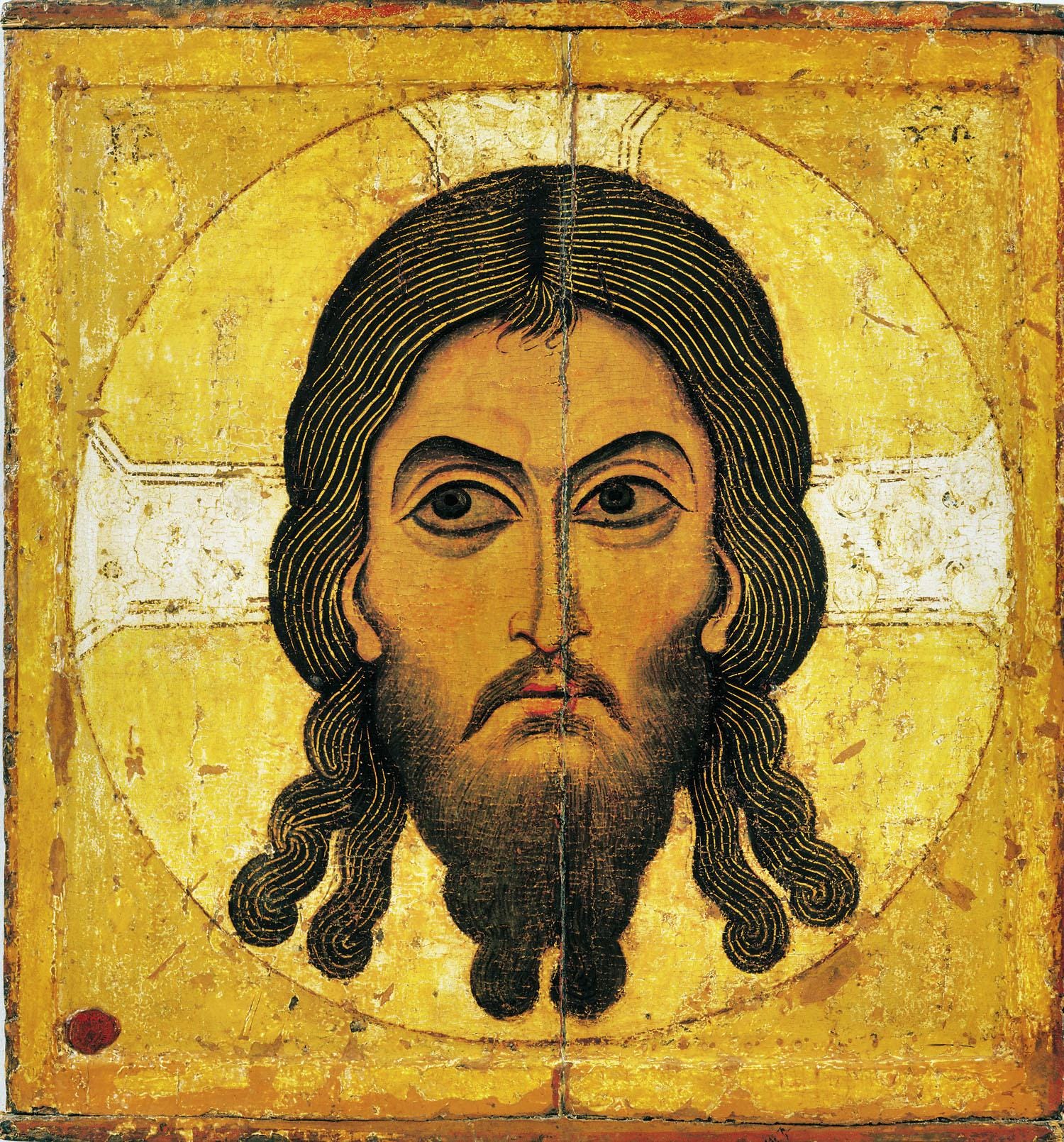
According to pious tradition, the King of Edessa, Agbar, sent a letter to Christ, imploring him to come to Edessa to heal him, but Christ, being unable to leave his ministry, set his face to a cloth and miraculously left an imprint of his face. When Agbar received this “mandylion,” he set his own face on it and was healed. Throughout Eastern Christendom, including Russia, there were copies of this icon, and then copies of those copies, all made with the hope of extending the healing power of the face of Christ. These copies of copies, faithfully but uniquely made by artists, make up a kind of stream that connects you to the mountain source, however remote it has become. Those who venerated these icons could look at them and imagine laying their own faces upon the face of Christ, like Agbar did, and feel themselves being spiritually healed. In this act of matching up my face to his, I am healed, and the face of Jesus becomes imprinted on mine. I become an icon of Christ.
And just so that you don’t think all of this is merely for Byzantine Christians, consider a beautiful painting by a living artist working in Tyler, Texas. The painter is Robert Puschautz and the image is called Advent II:
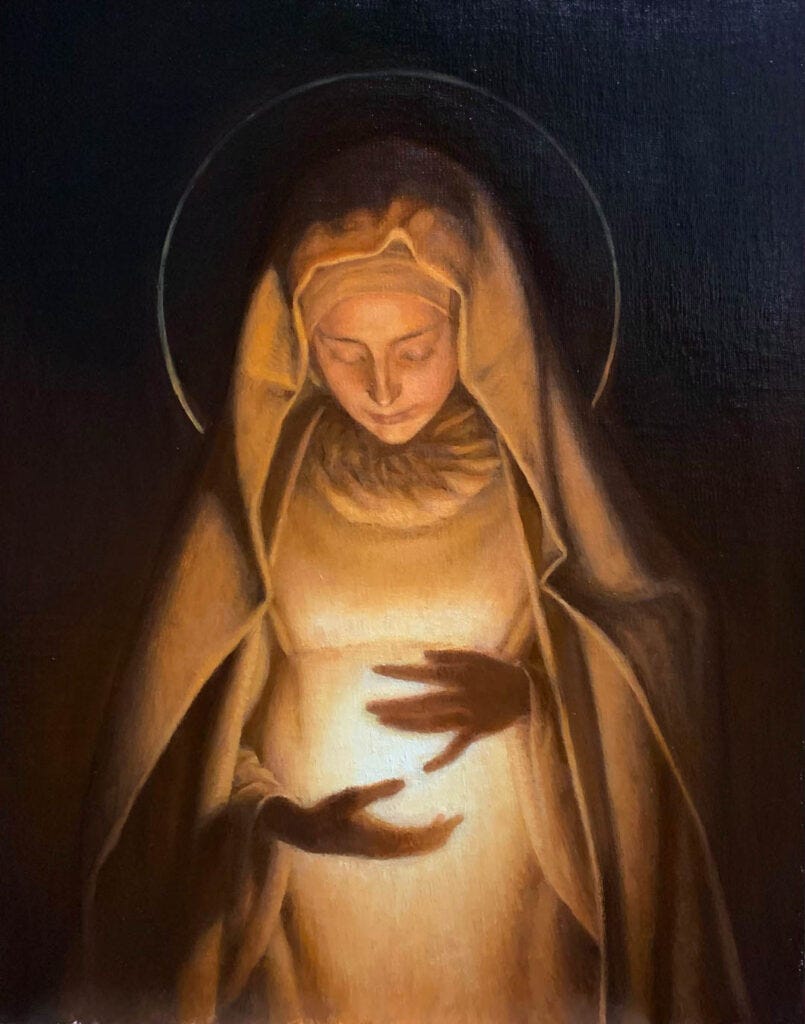
Have you ever seen a more perfect contemplative image for Advent?
Women who have carried life within know better than we men do something like what this feels like.
But Puschautz has given the gift of this contemplative experience of what it would be like to hold within the Word of God, to women and men. This is the secret fire, the inner light, that can heal your inner spiritual malnutrition and warm up the coldness of your inner Poughkeepsie. This is what art is good for.
As a thanks to my paid subscribers, I’d like to mail an image of “Advent” to you as a gift (although it won’t be before Christmas). If you are a paid subscriber or would like to be, please DM me to tell me if you’d like a copy of your own.